"Laffey in Harm's Way," Tom W. Freeman, © 1996. Used with permission pending.
The Ship That Would Not Die
USS Laffey (DD-724)
She survived six kamikaze hits, four bomb strikes, and eighty minutes of unrelenting attack. She never sank. She never surrendered.
A Destroyer Like No Other
USS Laffey (DD-724) is a Sumner-class destroyer commissioned on February 8, 1944. Named for Seaman Bartlett Laffey — a Civil War Medal of Honor recipient — she carried that legacy of courage into the bloodiest naval conflict in history.
In just over a year of service, she earned battle stars at Normandy, Southern France, and Okinawa. But it was eighty minutes off the coast of Japan on April 16, 1945 that wrote her name into history forever.
Today she rests at Patriots Point Naval & Maritime Museum in Mount Pleasant, South Carolina — the only surviving Sumner-class destroyer in the world — a permanent memorial to the men who served aboard her and the nation they defended.
Ship Specifications
June 1944
From Normandy to Cherbourg

Normandy coast — the theater of USS Laffey's first combat operations, June 1944
June 6, 1944
D-Day — Utah Beach
USS Laffey entered combat scarcely four months after commissioning.
On June 3, 1944, she departed England for Normandy as part of the enormous Allied naval force supporting Operation Neptune, the naval component of Operation Overlord.
Laffey escorted tugs, landing craft, and Dutch gunboats across the English Channel and arrived off Utah Beach at dawn on June 6, 1944 — D-Day.
During June 6 and 7, Laffey screened the invasion force from seaward attack, helping protect the ships and landing craft sustaining the Allied assault ashore.
June 8–9, 1944
Naval Gunfire Support
On June 8 and 9, Laffey shifted from screening duties to direct naval gunfire support.
Her 5-inch guns bombarded German positions ashore in support of Allied forces expanding the Normandy beachhead.
After expending ammunition and supplies, Laffey returned briefly to Plymouth, replenished, and quickly returned to the combat area.
June 12, 1944
The E-Boat Attack
On June 12, German S-boats — known to the Allies as E-boats — attacked Allied shipping off Normandy.
One of their torpedoes struck USS Nelson (DD-623), blowing away much of the destroyer's stern.
Laffey immediately pursued the attacking E-boats. Her aggressive response broke up their formation and prevented them from making further attacks against the vulnerable Allied shipping.
USS Laffey pursued the attackers and broke up the E-boat formation.
June 25, 1944
The Battle of Cherbourg
Less than two weeks later, Laffey returned to battle.
On June 25, 1944, she joined the Allied naval bombardment of the heavily fortified port of Cherbourg in support of advancing American ground forces.
Laffey served with the bombardment force supporting battleships USS Texas and USS Arkansas as Allied warships engaged powerful German coastal batteries.
The German shore defenses returned accurate heavy gunfire. During the engagement, a German shell ricocheted from the water and struck Laffey above the waterline. The projectile penetrated the ship but failed to explode.
Commander Frederick J. Becton continued the fight despite the enemy fire. As German batteries engaged the Allied force, Becton maneuvered USS Laffey between the shore batteries and heavier Allied ships, deliberately placing his destroyer in a position to draw fire away from the bombardment force. He continued engaging the enemy while positioning Laffey to protect withdrawing ships with gunfire or smoke if necessary.
For his leadership during the Normandy campaign and the Cherbourg bombardment, Commander Becton received the Silver Star.
Before Laffey became "The Ship That Would Not Die" at Okinawa, she had already earned her reputation under fire off Normandy.
Historical summary based on U.S. Naval History and Heritage Command records, including the Dictionary of American Naval Fighting Ships history of USS Laffey and official Navy accounts of the Normandy and Cherbourg operations.
Normandy proved Laffey's courage. Okinawa made her immortal.
April 16, 1945
Eighty Minutes of Hell
Laffey was assigned to Radar Picket Station No. 1 — the most exposed and most dangerous post in the waters off Okinawa. Radar picket destroyers were the first line of warning against incoming Japanese air attacks, and the Japanese knew it. They were priority targets.
The morning of April 16 was part of Kikusui No. 2 — the second of the massive, coordinated kamikaze offensives the Japanese launched against the Okinawa invasion fleet. Approximately fifty aircraft were dispatched in the attack. Around two dozen fixed on Laffey.
At approximately 8:27 a.m., the first aircraft appeared. Within minutes, waves of Vals, Zeros, and Judys were pressing attacks from multiple directions simultaneously — a deliberate tactic designed to overwhelm a ship's anti-aircraft defenses by forcing her gunners to divide their fire. Commander Frederick Julian Becton ordered flank speed and began violent evasive maneuvering, but the attacks came faster than the ship could turn.
The first kamikaze struck the aft 20mm gun mount. A second hit the stern. Bombs fell. More kamikazes followed. Fires broke out across the ship. Laffey's steering was damaged, forcing Becton to order manual steering from the fantail — men working the rudder by hand while the ship was still under attack. The dead and wounded were everywhere. But the guns did not stop.
At one point, with the ship burning and the attacks still coming, Becton was asked whether he intended to abandon ship. His answer, recorded in his memoir, was unequivocal: 'I'll never abandon ship as long as a gun will fire.' The guns kept firing.
In approximately eighty minutes, Laffey absorbed six kamikaze strikes and four bomb hits, was strafed repeatedly, and lost thirty-two men killed and more than seventy wounded. Her crew shot down nine aircraft and assisted in the destruction of others. She was still afloat. She was still fighting. She would not die.
Laffey was towed first to Kerama Retto — the fleet anchorage and repair base off Okinawa — and then to Guam, and finally to Puget Sound Naval Shipyard in Washington State for extensive repairs. The war ended before she could return to action. For her actions on April 16, 1945, USS Laffey was awarded the Presidential Unit Citation.
Her Story
February 8, 1944
Commissioned
USS Laffey is commissioned at Bath Iron Works in Bath, Maine. She is named for Seaman Bartlett Laffey, who received the Medal of Honor for his actions at the Battle of Nanshan Hill during the Civil War.
June 6, 1944
D-Day — Utah Beach
Laffey departs England on June 3 as part of the Allied naval force supporting Operation Neptune. She arrives off Utah Beach at dawn on June 6, escorting tugs, landing craft, and Dutch gunboats across the Channel. During June 6 and 7, she screens the invasion force from seaward attack.
June 8–25, 1944
Gunfire Support & Battle of Cherbourg
On June 8–9, Laffey shifts to direct naval gunfire support, bombarding German positions ashore. On June 12, she pursues German E-boats that torpedoed USS Nelson, breaking up their formation. On June 25, she joins the Allied bombardment of Cherbourg alongside USS Texas and USS Arkansas. A German shell ricochets from the water and strikes Laffey above the waterline — it penetrates the hull but fails to explode. Commander Becton maneuvers between the shore batteries and heavier Allied ships, drawing fire to protect the bombardment force. He receives the Silver Star for his leadership.
August 1944
Operation Dragoon — Southern France
Laffey supports the Allied invasion of Southern France, providing shore bombardment and screening operations along the French Riviera. A second battle star is added to her record.
Early 1945
Pacific Theater
Transferred to the Pacific Fleet, Laffey joins the massive Allied buildup for the final assault on Japan. She participates in operations at Iwo Jima and prepares for the invasion of Okinawa — the largest amphibious assault in the Pacific War.
April 16, 1945
Radar Picket Station No. 1 — Okinawa
Assigned to Radar Picket Station No. 1 during Kikusui No. 2 — the second mass kamikaze offensive of the Okinawa campaign — Laffey is attacked by approximately 22 Japanese aircraft over roughly 80 minutes. She absorbs six kamikaze strikes and four bomb hits, is strafed repeatedly, and loses thirty-two men killed and more than seventy wounded. Her guns never stop firing. She shoots down nine aircraft. She does not sink.
April–October 1945
Kerama Retto, Guam, and Puget Sound
Laffey is towed first to Kerama Retto — the fleet anchorage and emergency repair base off Okinawa — then to Guam, and finally to Puget Sound Naval Shipyard in Washington State for full repairs. The war ends before she can return to action. She is awarded the Presidential Unit Citation for her actions on April 16.
1945–1975
Post-War Service
Laffey serves in the post-war Navy, participating in operations during the Korean War era and serving as a training vessel. She is decommissioned in 1975 after more than three decades of service.
1981 — Present
Patriots Point — Permanent Memorial
USS Laffey is donated to Patriots Point Naval & Maritime Museum in Mount Pleasant, South Carolina, where she is preserved as a museum ship and National Historic Landmark. She is the only surviving Sumner-class destroyer in the world.
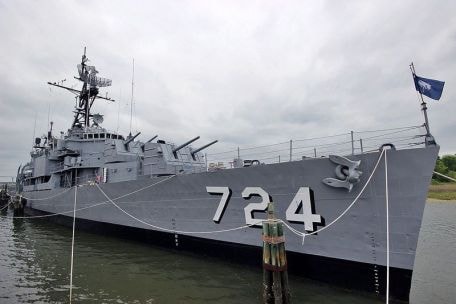
"She is the only surviving Sumner-class destroyer in the world."
A Living Memorial
USS Laffey was designated a National Historic Landmark in 1986. She is one of only a handful of WWII warships preserved as museum ships in the United States — and the only surviving destroyer of her class.
Every year, thousands of visitors walk her decks, stand at her gun mounts, and try to imagine what those eighty minutes were like. The USS Laffey Foundation works to ensure that experience remains possible for generations to come.